Quick Overview of Early Parkinson’s Signs
If you’re worried about subtle changes in yourself or a loved one, these are 7 early signs of Parkinson’s disease to watch for:
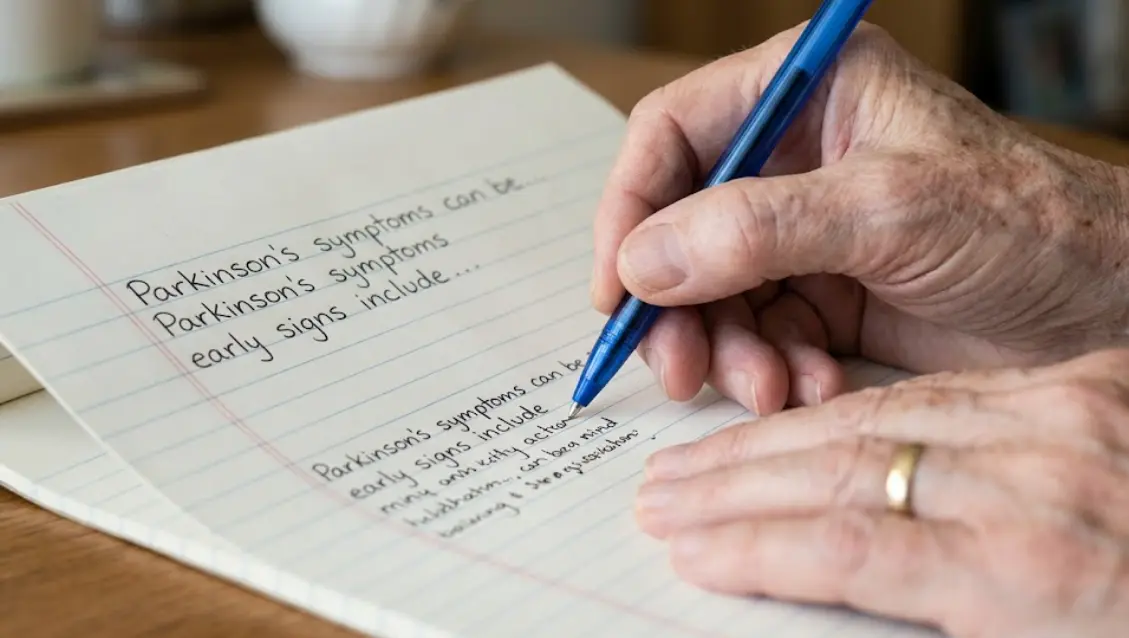
Smaller, cramped handwriting (micrographia)
Reduced sense of smell (anosmia)
Disturbed sleep patterns, especially acting out dreams
Reduced facial expression (masked face)
Softer or fading voice
Subtle balance or posture changes
Early mood or cognitive shifts (anxiety, apathy, slowed thinking)
These early signs of Parkinson’s often appear gradually and may be mistaken for normal aging.
About the Author: Amy Romero is the Chief Marketing Officer at Alliance Homecare. With over 20 years of experience in healthcare and tech, she leads the RN Ambassador Program to ensure families receive expert-led education and support.
Clinically Reviewed by: Alliance Homecare Nursing Team
Introduction: The Power of Clinical Vigilance
One of the most common concerns families share is this:
“My parent has Parkinson’s… does this mean I will too?”
It’s a valid and deeply human question.
While Parkinson’s disease can have a genetic component, most cases are not directly inherited in a predictable way. What matters more—especially in the early stages—is not fear of heredity, but awareness of subtle clinical changes.
In practice, early Parkinson’s is rarely identified from one dramatic symptom. Instead, it’s recognized through patterns—small, almost dismissible changes that accumulate over time.
From a nursing perspective, early detection often begins not with advanced testing, but with careful observation:
Changes in movement that others overlook
Behavioral shifts that seem “out of character”
Physical signs that appear before a diagnosis is even considered
The earlier these patterns are recognized, the more effectively families can plan, adapt, and seek appropriate care.
The 7 Early Signs: A Registered Nurse’s Checklist
In clinical settings, we are trained to look beyond the obvious tremor. Many early signs of Parkinson’s disease are subtle—and often noticed first by family members.
1. Micrographia & Fine Motor Changes
Patients often begin writing smaller and more cramped without realizing it.
This isn’t just handwriting—it reflects declining dopamine levels affecting fine motor control. Families may notice:
Difficulty buttoning shirts
Slower typing or texting
Reduced dexterity in daily tasks
A common pattern: “It started with messy handwriting, not shaking.”
2. Anosmia: The Hidden Red Flag
Loss of smell is one of the earliest—and most overlooked—clinical symptoms.
Patients may say:
“Food doesn’t taste the same”
“I can’t smell coffee anymore”
What’s important is timing. Anosmia can appear years before motor symptoms, making it a critical early indicator.
3. Sleep Architecture Disruptions
One of the most telling early signs often appears during sleep.
Specifically:
Acting out dreams (REM sleep behavior disorder)
Sudden movements, kicking, or talking during sleep
Partners are usually the first to notice this.
Clinically, this is significant because it reflects early neurological changes in brainstem regulation—often preceding diagnosis.
4. Facial Masking (Hypomimia)
Families may describe this as:
“They just don’t look like themselves anymore.”
This refers to reduced facial expressiveness:
Less blinking
Flattened emotional expression
Appearing disengaged, even when alert
It’s frequently misinterpreted as depression or disinterest.
5. Vocal Projection Changes
Voice changes are subtle but meaningful:
Softer speech
Monotone delivery
Words trailing off
In clinical observation, patients often don’t notice this—but others do:
“We keep asking them to repeat themselves.”
This reflects reduced muscle control involved in speech production.
6. Postural Instability & Movement Changes
Early posture changes may include:
Slight forward stooping
Reduced arm swing when walking
Slower transitions (e.g., standing up)
Importantly, these are not dramatic balance issues yet—but early coordination changes.
7. Cognitive & Mood Shifts
Non-motor symptoms are often the most misunderstood.
Early changes may include:
Increased anxiety
Apathy or reduced motivation
Slower thinking or processing
These are sometimes labeled as:
Stress
Burnout
Aging
But in context, they can be early neurological signs.
A Clinical Insight Most Articles Miss
In real-world care, these symptoms rarely appear all at once.
Instead, we often see:
2–3 subtle changes over time
Each dismissed individually
Only later recognized as a pattern
That pattern recognition is where clinical training becomes essential.
Distinguishing the Shake: Parkinson’s vs. Essential Tremor
Not all tremors are Parkinson’s.
Here’s a key clinical distinction:
Resting Tremor (Parkinson’s)
Appears when the body is at rest
Often described as a “pill-rolling” motion
May decrease with movement
Action Tremor (Essential Tremor)
Occurs during movement (e.g., holding a cup)
Often affects both hands symmetrically
Frequently includes head shaking
A detail families often miss:
Head tremors are more common in essential tremor, not Parkinson’s
Proper differentiation requires clinical assessment—not assumption.
The Alliance Difference: Why RN-Led Care Matters
In many home care settings, the focus is on assistance—help with daily tasks, mobility, and routines.
But Parkinson’s care requires something more:
Clinical awareness.
Subtle neurological changes can easily go unnoticed without trained observation. This is where RN-led care becomes critical.
A registered nurse can:
Identify early symptom progression
Monitor changes that impact treatment effectiveness
Communicate meaningful updates to neurologists
In practice, this creates a bridge between:
The home environment
The medical system
Families often tell us:
“We didn’t realize how much we were missing until a nurse pointed it out.”
That level of insight can significantly impact long-term outcomes.
Conclusion: Turning Concern into a Proactive Care Plan
Noticing early signs of Parkinson’s disease can feel uncertain—but it’s also an opportunity to act early and thoughtfully.
In clinical care, small changes often matter more than dramatic symptoms. Paying attention now can help ensure your loved one receives the right support at the right time.
You don’t have to figure this out alone.
To better understand what you’re seeing and explore next steps, visit:
👉 Alliance Homecare
Speaking with an RN who understands Parkinson’s progression can provide clarity, reassurance, and a more confident path forward.
Medical Disclaimer:
The information provided in this article is for general educational purposes only and is not a substitute for professional medical advice, diagnosis, or treatment. Reliance on any information provided on this website is solely at your own risk. Always consult with a qualified physician or healthcare provider regarding any medical concerns. If you are experiencing a medical emergency, please call 911 or go to the nearest emergency room immediately.