

Diane Sirakovsky
RN, BSN, PNHNP-BC
Founder, Chief Clinical Strategist
Cerebral Palsy (CP) is the most common motor disability in childhood, defined as a group of disorders that affect a person’s ability to move and maintain balance and posture. Because its impact ranges from mild to profound, with symptoms varying significantly for every individual, a generic, one-size-fits-all approach to care is insufficient. Thriving with CP requires a truly holistic and comprehensive Cerebral Palsy Care Plan. This plan must go beyond isolated medical tasks to support the entire family—emotionally, logistically, and physically.
At Alliance Homecare, we understand this. For families in New York and New Jersey, we know that managing Cerebral Palsy Home Care also means navigating unique urban challenges, from coordinating fragmented specialty services to managing daily accessibility. Our care is grounded in compassion, connection, dignity, and a family-centered mission, delivering the trusted, unparalleled support your loved one deserves.
Understanding Cerebral Palsy and Its Impact
What Is Cerebral Palsy?
Cerebral Palsy is a group of conditions resulting from abnormal development of the brain or damage to the developing brain, which affects a person’s ability to control their muscles. This damage, which most often occurs before birth, impacts movement, posture, and balance. The effects can be localized to one or two limbs or affect the whole body.
This may manifest as:
- Spasticity: Stiff, tight muscles and exaggerated reflexes. This is the most common type of CP.
- Dyskinesia: Uncontrollable movements, which can be slow and writhing or rapid and jerky.
- Ataxia: A lack of muscle coordination and balance.
While CP itself does not worsen over time, it is a lifelong condition, and the exact symptoms can change over a person’s lifetime. Many individuals also manage related conditions, such as seizures (epilepsy), intellectual disabilities, problems with vision or hearing, and challenges with speech or swallowing (dysphagia).
Common Challenges for Individuals and Families
The impact of CP extends far beyond the individual, creating a triptych of challenges for the whole family. Physically, this involves the daily management of motor skills, mobility, and potential pain.
Emotionally and psychosocially, the burden on caregivers can be immense. Studies show high levels of stress, anxiety, and depression among parents, with a statistically significant association found between the child’s level of motor impairment and the “psychosocial and economic burden on families”. This parental stress can, in turn, influence care practices.
Logistically, especially for Cerebral Palsy home care New York and New Jersey, families face a complex, fragmented system. This includes navigating physical accessibility barriers on public transport or in schools and the significant burden of coordinating multiple, specialized services. In New York State, for example, many families report spending significant time coordinating care, with only 11% feeling their child receives care in a “well-functioning system”.
Components of a Comprehensive Cerebral Palsy Care Plan
A truly effective plan integrates multiple disciplines to create a synergistic support system. These components cannot exist in silos; they must work in coordination to achieve the best possible outcomes.
Skilled Nursing Care for Cerebral Palsy at Home
Skilled nursing care for cerebral palsy at home forms the clinical backbone of the plan. A Registered Nurse (RN) is pivotal in managing chronic conditions like CP. The nurse develops and oversees personalized care plans and manages complex, day-to-day medical needs. This includes medication administration, management of G-tube (gastrostomy) feedings, respiratory support, pain management, and monitoring for potential complications like contractures or skin breakdown. Critically, the skilled nurse also educates and supports the family, teaching them how to handle medical tasks and providing essential respite.
Physical and Occupational Therapy
Therapy is essential for maximizing potential and promoting independence.
Physical Therapy (PT) focuses on improving gross motor skills. This includes programs for muscle strength, balance, and mobility—whether that is walking, using a walker, or operating a wheelchair. A key goal of PT is preventing or managing contractures (chronic muscle shortening) that can result from high muscle tone.
Occupational Therapy (OT) focuses on adapting to the tasks of daily living. OT helps individuals improve fine motor skills for activities like eating, dressing, and writing, helping them “improve function and make the most of a child’s mobility” in their home and school environments.
Speech and Language Therapy is often included to improve communication and, just as importantly, to address related swallowing disorders.
Assistive Devices and Adaptive Technologies
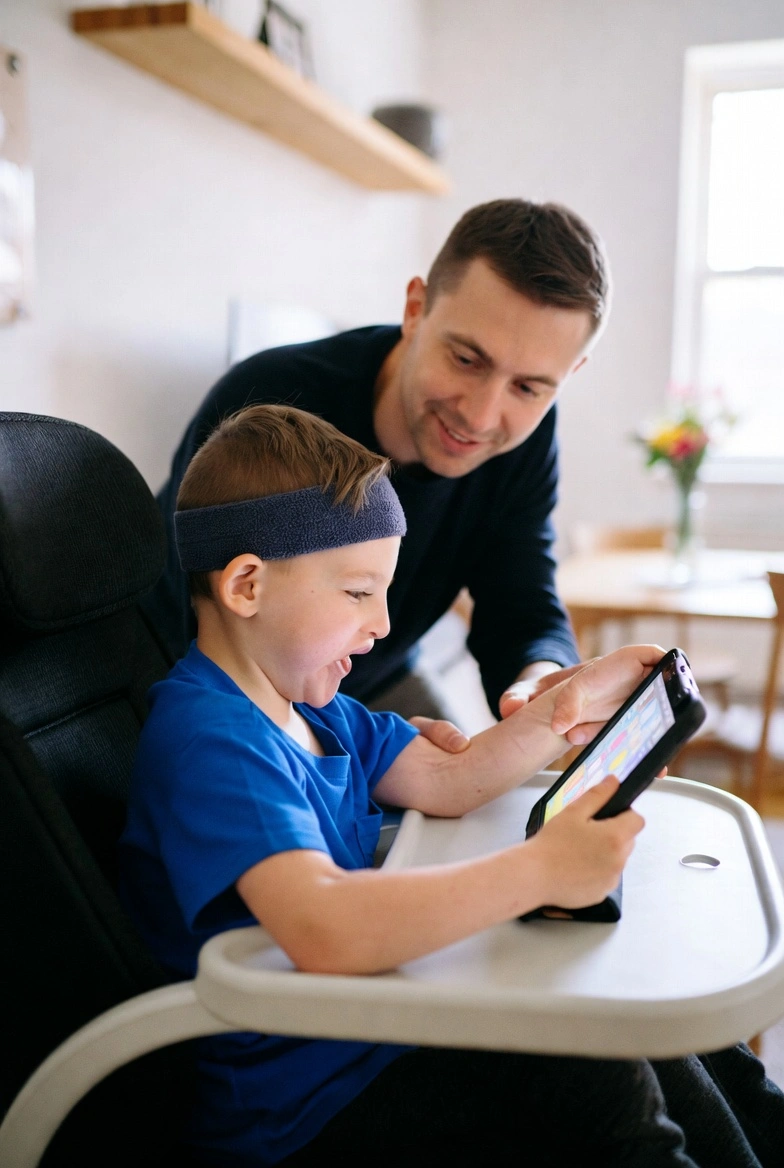
A successful Cerebral Palsy Care Plan integrates the right tools to foster independence and enhance communication. This includes mobility aids like orthotics (braces), walkers, and wheelchairs, as well as adaptive technologies such as specialized computers or voice synthesizers that provide a voice to individuals with speech challenges.
These components are most effective when guided by an interdisciplinary team. The American Academy of Pediatrics (AAP) recommends a “patient- and family-centered care team” that encourages shared decision-making. When therapists, nurses, doctors, and the family work from a unified plan, outcomes improve. This collaborative model is proven to increase patient safety, reduce hospitalization rates, and minimize complications. The skilled home nurse is the key—they are present daily to reinforce therapeutic goals, making progress a part of everyday life rather than just a weekly appointment.
How to Find and Choose the Right Caregiver for Cerebral Palsy
Evaluating Caregiver Qualifications
When you ask how to find a caregiver for cerebral palsy, you are looking for a trusted partner. This requires evaluating two distinct skill sets.
First are the “hard skills.” You must verify their objective qualifications. In our region, this means ensuring they meet New York State Department of Health (DOH) or New Jersey training requirements for a Home Health Aide (HHA). Ask about their specific clinical experience with CP, such as managing spasticity, mobility transfers, or G-tubes.
Second, and just as important, are the “soft skills.” A qualified caregiver must demonstrate compassion, patience, and reliability. A caregiver’s empathy and positive attitude are critical to alleviating the family’s psychosocial stress.
Questions to Ask Prospective Caregivers
A structured interview is key to finding the right fit. Go beyond the résumé and ask scenario-based questions, such as, “How would you handle…?”. When interviewing an agency, ask about their process for screening caregivers for these crucial “soft skills.”
Category | Key Question to Ask an Agency | Why It Matters |
Clinical Qualifications | “Are all your caregivers certified (e.g., HHA) per NYS DOH standards? What specific training do they receive for CP-related needs like spasticity or G-tubes?” | Ensures objective, “hard skill” competence and compliance. |
Vetting & Compassion | “What is your process for screening caregivers’ ‘soft skills’ like compassion and reliability?” | Vets the person, not just the résumé, which is critical for alleviating family stress. |
Care Coordination | “How does your agency coordinate with my child’s therapists, doctors, and school? Who is my single point of contact?” | Addresses the “communication gaps” and logistical chaos that burden families. |
Reliability & Backup | “What is your protocol for a medical emergency? What happens if our regular caregiver is sick?” | Assesses the agency’s reliability and infrastructure, a key benefit over a private hire. |
Live-in Care for Adults with Cerebral Palsy
For individuals requiring continuous support, Live-in care for adults with cerebral palsy offers a powerful solution. This model provides 24/7 safety and supervision, allowing the individual to remain in the comfort and familiarity of their own home. This consistency is especially crucial as adults with CP age and transition away from the pediatric care system, a time when finding knowledgeable adult care providers can be difficult. Live-in care fosters independence by supporting, not dictating, a personal routine and provides vital companionship, alleviating the isolation that can accompany disability.
Understanding the Cost of Home Care for Cerebral Palsy
Factors Affecting Homecare Costs
The Cost of home care for cerebral palsy varies based on several key factors:
- Level of Skill: The cost will differ if the plan requires 24/7 skilled nursing (RN) versus a Home Health Aide (HHA) for personal care and support.
- Hours of Care: The total number of care hours needed per day or week.
- Severity of Condition: The primary driver. Individuals with more complex motor impairments or co-occurring medical needs will require more intensive, and thus more costly, care.
- Geographic Location: Rates for home care services vary by state and region.
It is essential to consider the “hidden” indirect costs. Studies show that “caregiver productivity losses”—parents leaving the workforce to provide care—can account for nearly 60% of the total lifetime financial burden, an amount that often far exceeds direct medical bills. Investing in professional care can often offset this larger, hidden cost by allowing family members to maintain their careers.
Insurance and Financial Assistance Options
Professional Cerebral Palsy Home Care can be funded through several pathways. Private insurance (PPO/HMO plans) may cover “medically necessary” services, such as skilled nursing or in-home therapies.
For families who qualify, Medicaid is a primary payer for long-term services and supports. Many states offer “waiver” programs that fund home and community-based services (HCBS) to help individuals avoid institutionalization.
In New York: The Office for People With Developmental Disabilities (OPWDD) provides services for individuals with developmental disabilities, including CP, through the HCBS Waiver. The “Care at Home” Waiver is another option for children.
In New Jersey: The Division of Developmental Disabilities (DDD) administers similar support through its Supports Program and Community Care Program, funded by the 1915(c) waiver.
Additionally, numerous non-profit organizations and foundations offer grants to families for medical equipment, therapies, and other care-related needs.
The Alliance Homecare Difference: Our Commitment to Quality Care
At Alliance Homecare, our commitment to quality Cerebral Palsy Home Care is defined by our core values: compassion, respect, and collaboration. We were founded on the idea of creating a family-like bond, and this is embodied by our “Grandma Rule®” philosophy. When hiring, we ask one question: “Would I trust this person to care for my own grandmother?”.
This principle is not just a slogan; it is our process. It guides our entire Cerebral Palsy Care Plan. It drives our commitment to continuous professional development and empathy training for our caregivers. It is the foundation for our RN-led care management, which ensures open, transparent communication and a true partnership between our team, your family, and your entire medical home—finally closing the “communication gaps” that cause so much stress.
Looking Ahead: Innovations and Future Directions in CP Care
The field of Pediatric Cerebral Palsy Care is dynamic. As an informed provider, Alliance Homecare stays current with emerging trends. Telehealth (telerehabilitation) is proving effective for maintaining therapeutic gains and managing care remotely, a trend accelerated by the recent pandemic. New assistive technologies, including robotics and virtual reality, are being used to complement traditional occupational therapy and enhance motor outcomes. Furthermore, artificial intelligence (AI) is being explored for clinical decision support and patient monitoring. We see these innovations in CP care not as replacements for human touch, but as powerful tools to integrate into a holistic plan, enabling more proactive and personalized support.
Conclusion
Navigating care for a loved one with Cerebral Palsy is a profound challenge, but you do not have to do it alone. A holistic, personalized Cerebral Palsy Care Plan that addresses the complex medical, emotional, and logistical needs of the entire family can truly enhance quality of life. Alliance Homecare is dedicated to being your trusted partner on this journey, providing care grounded in compassion and dignity. Contact us today for a personalized, compassionate consultation to discuss your family’s unique needs.