

Diane Sirakovsky
RN, BSN, PNHNP-BC
Founder, Chief Clinical Strategist
In my years of home care practice, I have seen many well-meaning families purchase expensive, complex “brain training” gadgets for their aging parents. More often than not, I find these devices months later, gathering dust on a shelf. The reason is rarely a lack of ability; it is usually a lack of connection.
When an activity feels like a medical test or a chore, seniors naturally disengage. From a nursing perspective, the “best” game is not necessarily the one with the most advanced algorithm—it is the one your loved one will actually play consistently. Consistency is key to cognitive maintenance. At Alliance Homecare, we focus on activities that are accessible, enjoyable, and rooted in familiar routines. Here are seven brain games for seniors that prioritize engagement over frustration, turning mental stimulation into a dignified part of daily life.
Why You Should Play With Them (Not Just Watch)
There is a significant clinical difference between passive activity and active engagement. Handing a senior a tablet and walking away is passive; sitting with them and discussing the puzzle is active engagement. Social isolation accelerates cognitive decline often faster than biological aging alone. Games should be a bridge to conversation—when a senior explains their logic, they are exercising executive function and speech centers simultaneously.
The “Daily Ritual” Games (Digital)
Many families assume seniors are averse to technology, but the iPad can be a wonderful tool when used correctly. We recommend digital games that are short and repeatable, preventing cognitive fatigue.
1. Wordle (The Daily Vocabulary Check)
Wordle has become a favorite because it is low-pressure: one word, once a day. It acts as a daily “vocabulary check” that feels modern and relevant. More importantly, it provides a social touchpoint—many of our clients enjoy comparing their daily results with their grandchildren via text, giving them a shared topic of conversation that has nothing to do with health or doctors.
2. NYT Connections (Pattern Recognition & Categorization)
Connections is a fantastic mental workout that requires the player to group words into categories. This exercises associative memory and pattern recognition. It challenges the brain to look past the surface meaning of a word to find deeper logical links, which helps maintain mental organizational skills used in daily life.
3. NYT Strands (Cognitive Flexibility & Thematic Search)
As the newest addition to the NYT suite, Strands is exceptionally beneficial for seniors. It requires finding theme-related words in a letter grid, exercising cognitive flexibility. From a clinical standpoint, it encourages “divergent thinking”—the ability to scan a complex environment and link disparate pieces of information to a central theme.
The Classics for Logic & Focus (Paper)
While digital options are great, there is a tangible benefit to pen-and-paper games. Clinical Note: Always opt for Large Print. Small fonts can cause eye strain and headaches, which are often mistaken for cognitive fatigue.
4. Sudoku (Logic without Words)
Sudoku is excellent because it relies purely on logic and number placement, bypassing language centers that might be affected by certain types of aphasia or memory loss. It encourages the brain to think sequentially and predict outcomes, keeping the “logical engine” of the brain active.
5. Word Finder (Visual Scanning & Safety Skills)
Word search puzzles practice a vital real-world skill: visual scanning. This is the same cognitive skill required to find a specific medication bottle on a crowded table or spot a potential tripping hazard on the floor. By practicing visual scanning in a game, we are subtly reinforcing safety skills for daily living.
Games for Language & Motor Skills
6. Crossword Puzzles (The Gold Standard)
Crosswords remain the gold standard for memory recall and general knowledge retention. They require accessing long-term memory stores to retrieve facts and vocabulary. We encourage doing these collaboratively; two brains working on one Sunday puzzle is a bonding experience, not just a solo struggle.
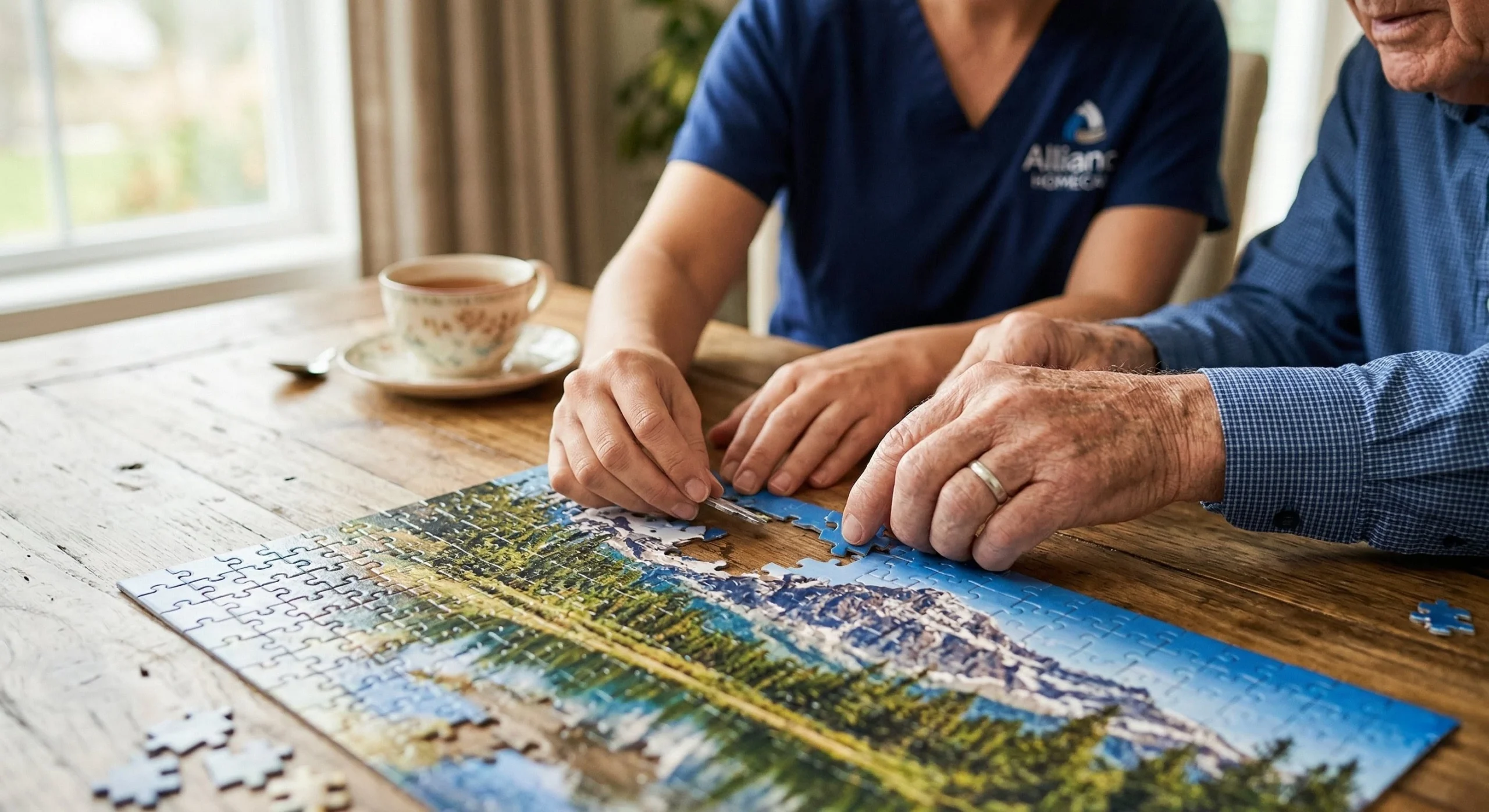
7. Jigsaw Puzzles (For Fine Motor Skills & Spatial Reasoning)
Cognitive health is deeply linked to physical capability. Jigsaw puzzles are unique because they combine visual-spatial problem solving with fine motor skills. Handling small puzzle pieces requires dexterity and pincer grasp strength, which helps keep fingers nimble for tasks like buttoning shirts or holding utensils.
Home is the Best Place to Play
Environment plays a massive role in cognitive performance. At home, we control the environment—adjusting lighting to reduce glare and eliminating background noise. This transforms the experience from “institutional entertainment” into dignified, private play.
Need a Game Partner? We Can Help
We cannot stop the aging process, but we can certainly make the days sharper, more engaging, and more enjoyable. The right game, played with the right person, creates moments of connection that are medically and emotionally beneficial.
If you are looking for a companion in the NYC or NJ area who matches your loved one’s personality—someone who knows when to challenge them and when to simply share a laugh over a puzzle—contact Alliance Homecare today. Let us help you find the perfect partner for your loved one’s care journey. Call us directly at 646-989-3936.
Medical Disclaimer:
The information provided in this article is for general educational purposes only and is not a substitute for professional medical advice, diagnosis, or treatment. Reliance on any information provided on this website is solely at your own risk. Always consult with a qualified physician or healthcare provider regarding any medical concerns. If you are experiencing a medical emergency, please call 911 or go to the nearest emergency room immediately.